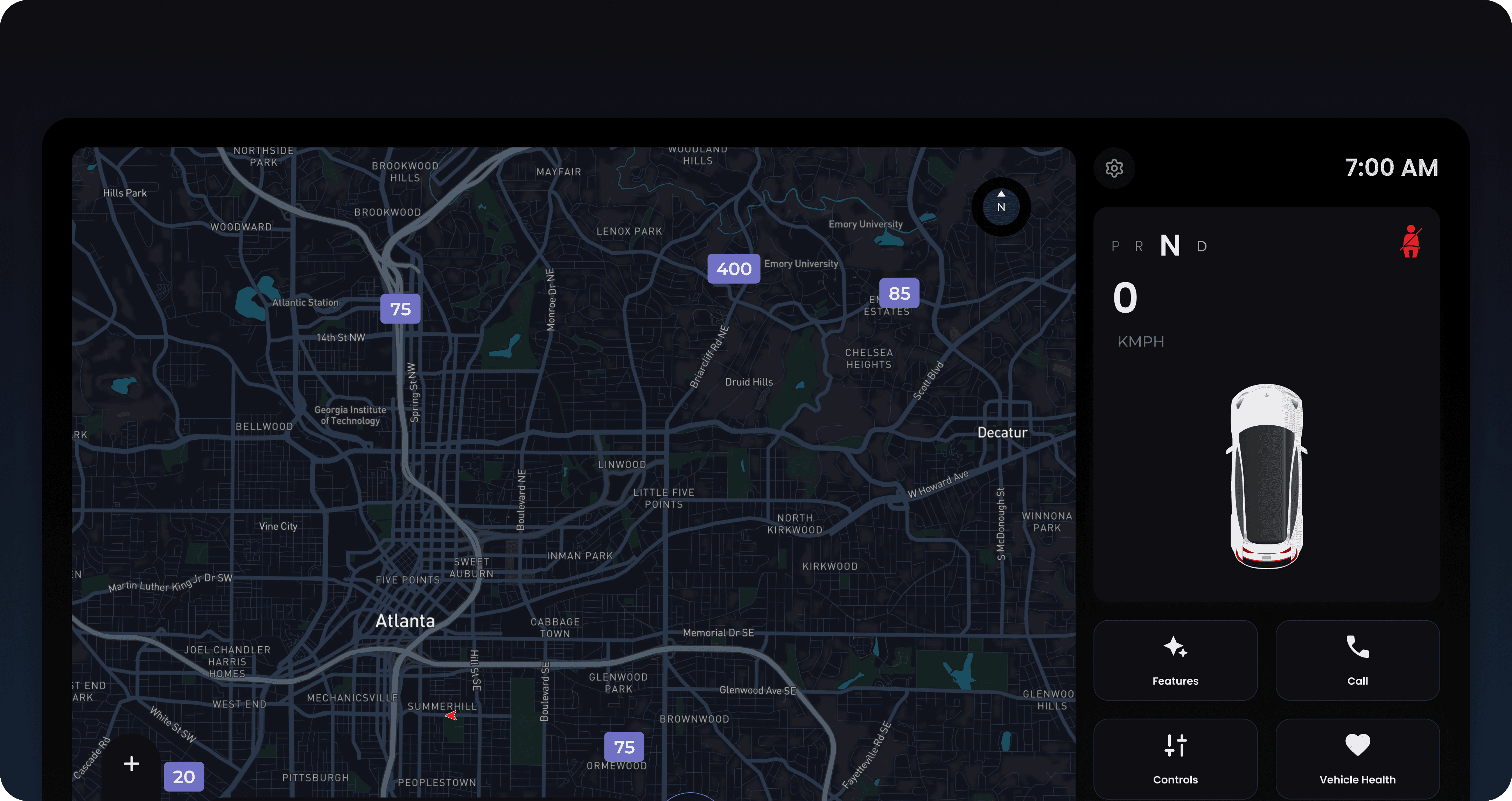
Nova - Redefining The Relationship Between Driver & Vehicle.

Nova AI is an intelligent IVIS co-pilot designed to bridge the gap between high-tech automation and road safety. By transforming the In-Vehicle Infotainment System (IVIS) into a proactive partner, Nova utilizes predictive assistance and context-aware interactions to slash cognitive load. From preempting mechanical failures to adaptive rerouting, Nova ensures that while the car gets smarter, the driver stays focused on what matters most: the road.
Role

Role

UX Researcher & Designer

UX Researcher & Designer

UX Researcher & Designer

Industry

Industry

Automobile

Automobile

Team Size

Team Size

4 members

4 members

Timeline

Timeline

Oct 2025 - Dec 2025

Oct 2025 - Dec 2025

Problem Statement

Driver interaction with IVIS systems increases distraction and cognitive workload. Complex navigation tasks demand sustained attention, while delayed responses to accidents or mechanical failures can result in life-threatening consequences. AI-based personal assistants offer potential solutions by enabling predictive assistance, context-aware interaction, automated emergency detection, and adaptive rerouting.

Cognitive Load

Cognitive Load

Drivers are often bombarded with non-essential data, leading to "glance fatigue," which increases the risk of lane deviation and delayed braking.

Trust & Transparency

Trust & Transparency

When a car suddenly suggests a new route or flags a mechanical issue without context, leads to system abandonment or distrust.

Context Information

Context Information

"Engine has some issue" is indicated with just an icon. For normal users, this information is stressful and difficult to interpret. Exactly what is the issue?

UX Road Map

Our roadmap was divided into a three-phase User-Centered Design (UCD) process:

Aug-Sep

Empathize Phase

Aug-Sep

Empathize Phase

Oct-Nov

Ideation & Prototype Phase

Oct-Nov

Ideation & Prototype Phase

Nov-Dec

Testing Phase

Nov-Dec

Testing Phase

Emphatize Phase

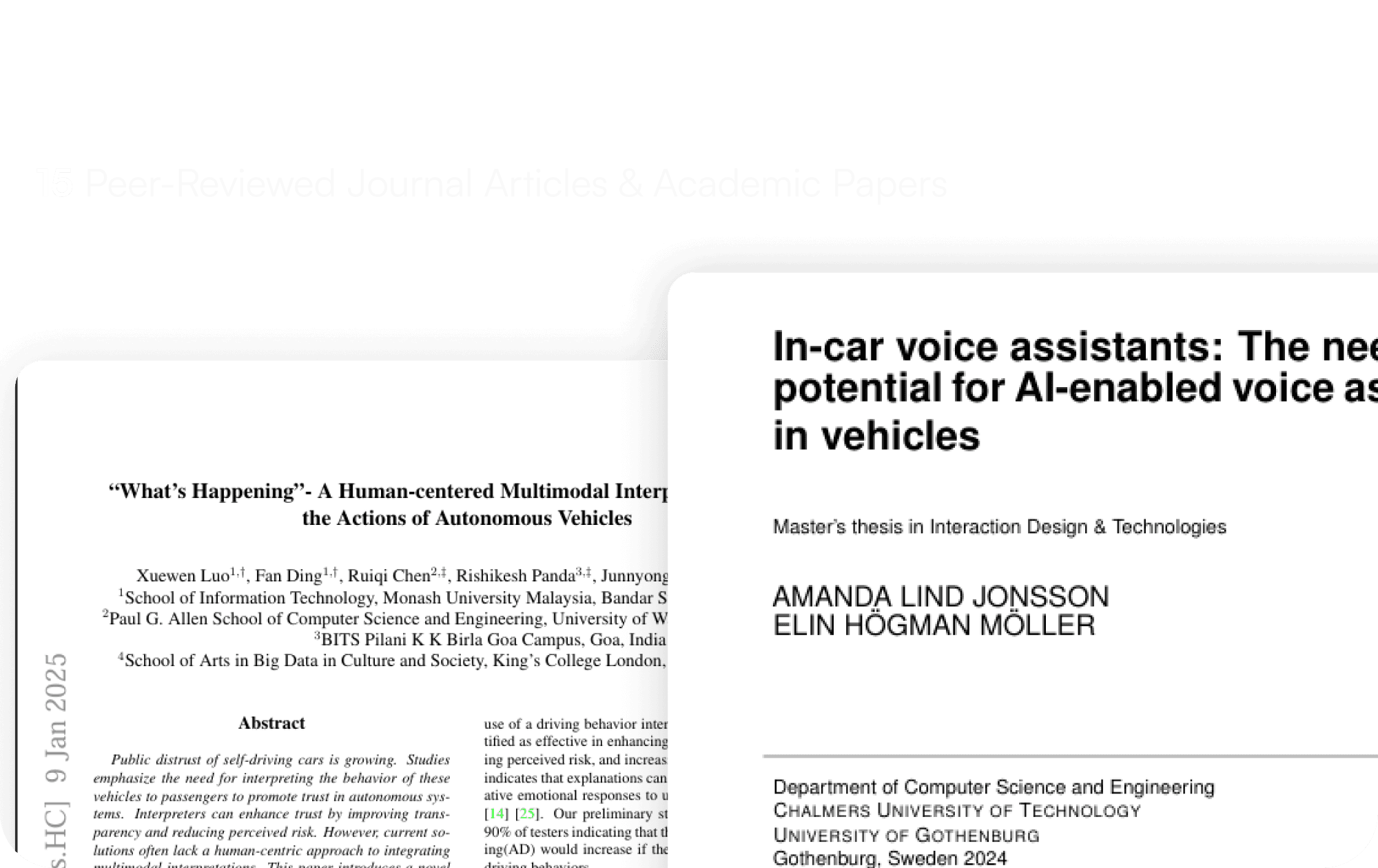
In this phase, insights were synthesized from user surveys, observational task analysis, and 15 research articles focused on AI trust, cognitive workload, and multimodal ergonomics.


Primary Research Question:

Primary Research Question:

  • How might we design an AI-assisted in-car infotainment system (IVIS) be designed to improve safety, usability, trust, and human-AI collaboration while minimizing driver distraction?

  • How might we design an AI-assisted in-car infotainment system (IVIS) be designed to improve safety, usability, trust, and human-AI collaboration while minimizing driver distraction?

  • How might we design an AI-assisted in-car infotainment system (IVIS) be designed to improve safety, usability, trust, and human-AI collaboration while minimizing driver distraction?

Sub Questions:

Sub Questions:

  • What multimodal input combinations (voice, visual, haptic) best minimize cognitive load during navigation tasks?


  • How does the provision of explainable AI (XAI) feedback influence driver trust and situational awareness?


  • How can real-time anomaly detection maintain high sensitivity without creating excessive false alarms for the driver?


  • What multimodal input combinations (voice, visual, haptic) best minimize cognitive load during navigation tasks?


  • How does the provision of explainable AI (XAI) feedback influence driver trust and situational awareness?


  • How can real-time anomaly detection maintain high sensitivity without creating excessive false alarms for the driver?


  • What multimodal input combinations (voice, visual, haptic) best minimize cognitive load during navigation tasks?


  • How does the provision of explainable AI (XAI) feedback influence driver trust and situational awareness?


  • How can real-time anomaly detection maintain high sensitivity without creating excessive false alarms for the driver?


Secondary Research

Secondary Research

A total of 15 articles were reviewed across four core functional domains: emergency detection, traffic updates, adaptive rerouting, and multimodal interaction, to support our research questions.

A total of 15 articles were reviewed across four core functional domains: emergency detection, traffic updates, adaptive rerouting, and multimodal interaction, to support our research questions.

A total of 15 articles were reviewed across four core functional domains: emergency detection, traffic updates, adaptive rerouting, and multimodal interaction, to support our research questions.

01

Latency & Reliability:

Multimodal sensing requires sub-5-second processing to be effective in emergency scenarios.

02

02

Human-in-the-loop:

Automated actions (like emergency calling) require a confirmation/cancel loop to ensure driver agency.

03

03

Information Density:

Audio-first alerts are critical for significant traffic changes to prevent visual "glance fatigue".

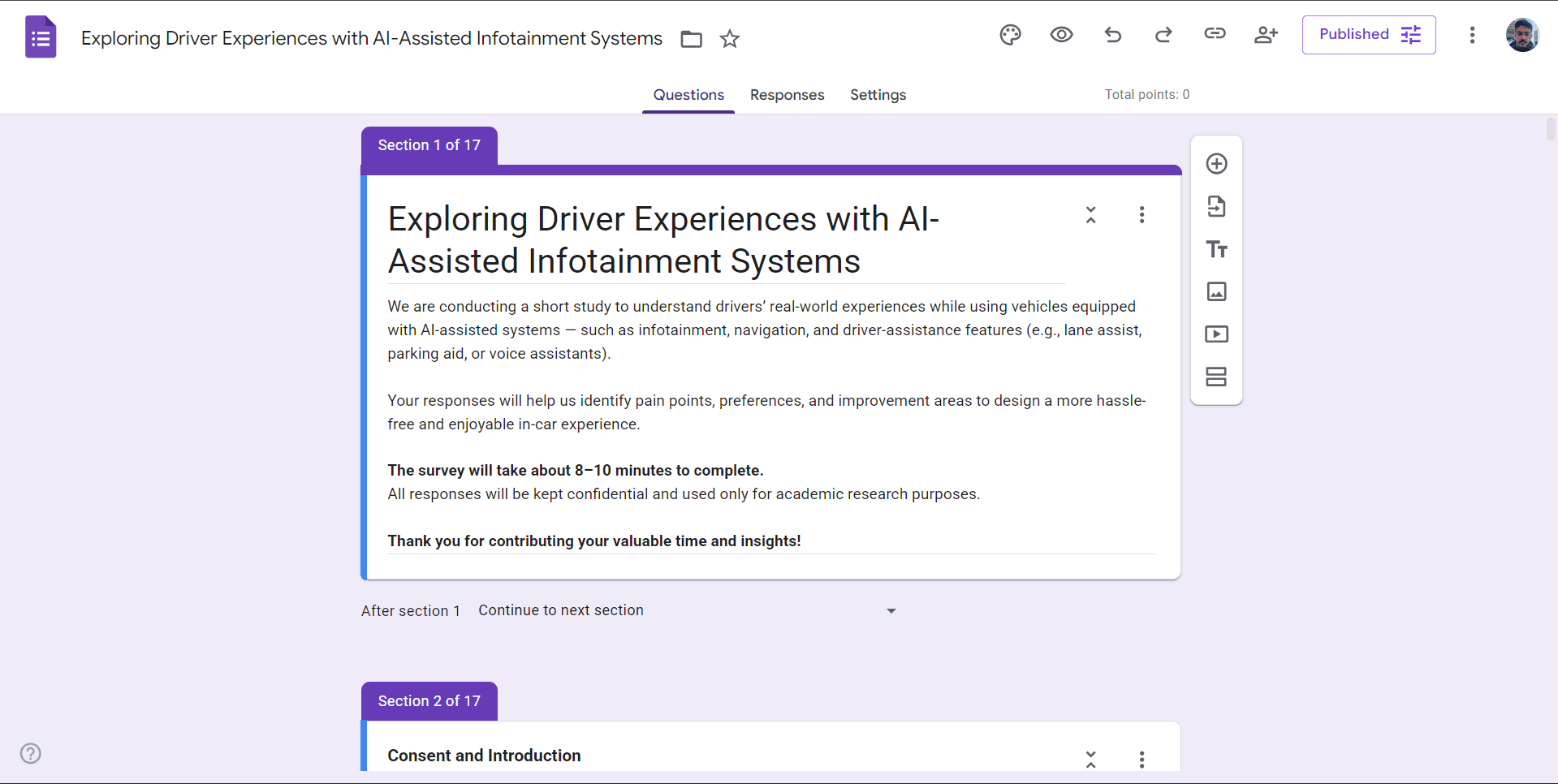
User Survey

User Survey

A total of 26 responses were collected from drivers aged 18 and above who helped to understand the "why" behind driving frustrations.

A total of 26 responses were collected from drivers aged 18 and above who helped to understand the "why" behind driving frustrations.

A total of 26 responses were collected from drivers aged 18 and above who helped to understand the "why" behind driving frustrations.

01

01

The "Why" Matters:

Drivers explicitly need trusted AI guidance that provides simple explanations alongside route suggestions.

02

02

Multimodal Clarity:

There is a strong demand for clear, combined audio and visual reroute alerts.

03

03

Control and Goals:

Drivers are primarily motivated by saving time and avoiding stress. They want options to choose between the fastest, safest, or fairest routes to reach their destinations reliably.

04

04

Key Pain Points:

Drivers reported immense frustration with delayed traffic updates, inaccurate ETAs, intrusive alerts that overwhelm them while driving, and abruptly suggesting unfamiliar reroutes without offering any transparent reasoning.
Observational Task Analysis

Observational Task Analysis

Observational Task Analysis

An observational task analysis was conducted with 2 drivers to evaluate real-time driver interactions with existing in-vehicle infotainment systems (IVIS) and connected smartphones.

An observational task analysis was conducted with 2 drivers to evaluate real-time driver interactions with existing in-vehicle infotainment systems (IVIS) and connected smartphones.

An observational task analysis was conducted with 2 drivers to evaluate real-time driver interactions with existing in-vehicle infotainment systems (IVIS) and connected smartphones.

Navigation & Route Management

Navigation & Route Management

While users prefer typing on their phones before a trip, they switch entirely to voice commands while in motion.

Observation: The most dangerous cognitive spike occurs when drivers attempt to evaluate and change routes mid-trip, highlighting a critical need for low-effort, transparent rerouting assistance.

Communication Friction

Current voice assistants frequently fail to recognize specific contact names (especially those saved with emojis), forcing drivers to manually scroll through digital phonebooks.

Observation: This creates a dangerous loop: vehicle vibrations cause screen misclicks,and drastically increasing visual distraction from the road.

Environment & Media Controls

Environment & Media Controls

Touchscreen-heavy interfaces for basic functions like climate and media control require precise tapping, dangerously pulling the driver's eyes away from the road.

Observation: Drivers frequently made adjustments and strongly prefer the tactile feedback of mechanical steering wheel buttons or highly reliable voice inputs over navigating deep touchscreen menus.

Affinity Diagram

Based on the insights gathered from the survey and observation task analysis, an affinity diagram was created covering 4 categories: Goals, Motivations, Need and Pain Points of the users.

Based on the insights gathered from the survey and observation task analysis, an affinity diagram was created covering 4 categories: Goals, Motivations, Need and Pain Points of the users.

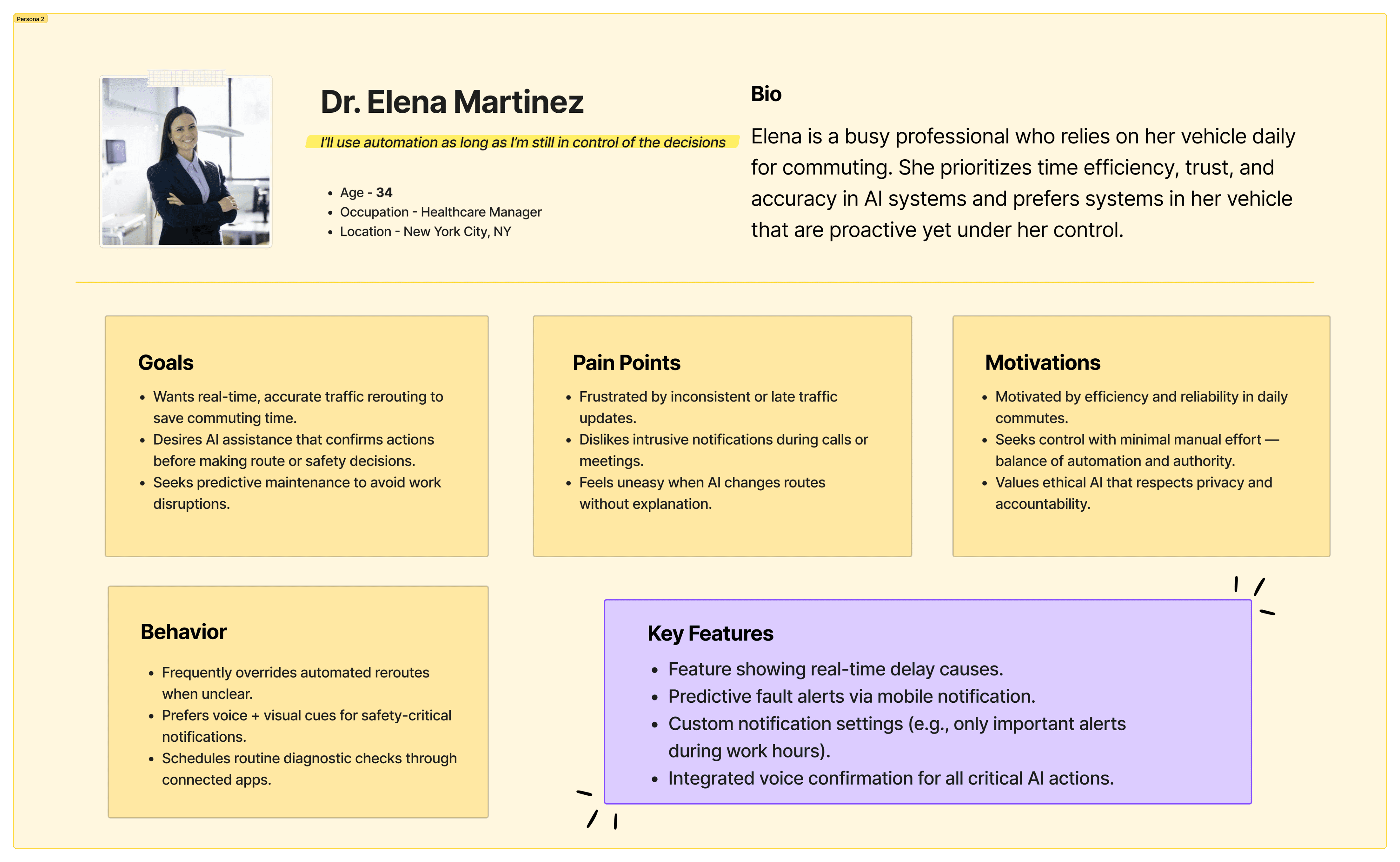
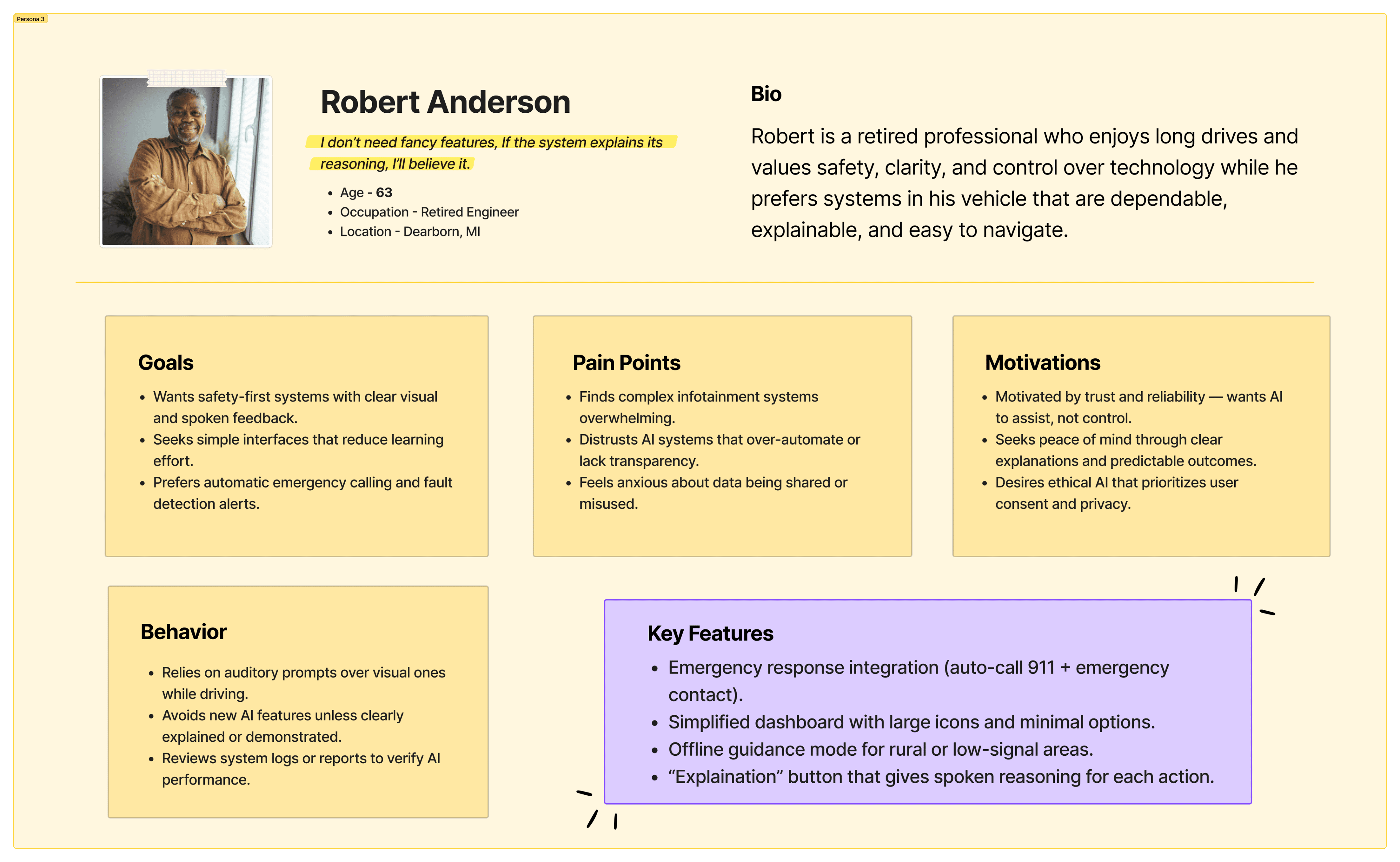
User Persona

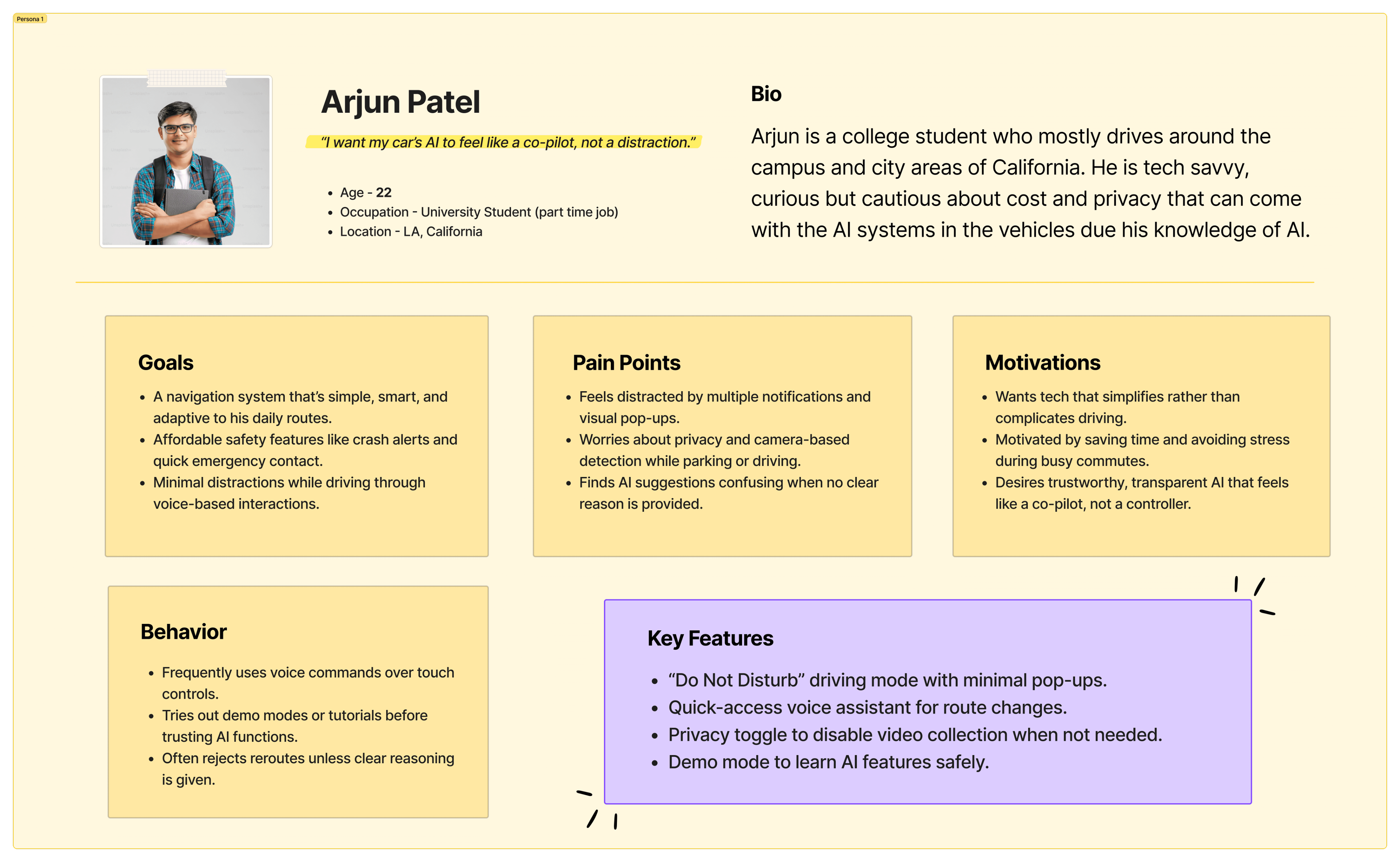
We synthesized our research into three personas to guide our 3 Core feature pillars: Automation, Organization, & Transparency

We synthesized our research into three personas to guide our 3 Core feature pillars: Automation, Organization, & Transparency

Ideation & Prototyping Phase

In this phase, research insights were translated into low-fidelity wireframes and a high-fidelity prototype. We focused on explainable AI and progressive disclosure to reduce cognitive load through seamless multimodal interactions.

In this phase, research insights were translated into low-fidelity wireframes and a high-fidelity prototype. We focused on explainable AI and progressive disclosure to reduce cognitive load through seamless multimodal interactions.

Low fidelity Wireframe

The primary goal of the low-fidelity phase was to establish a strict information hierarchy that minimized the driver's visual travel time. Rapid iteration on layouts was done using a "Zones of Reach" framework, i.e., UI/UX, to ensure that the most important and frequent interactions are physically accessible to the driver with minimal effort and distraction.

The primary goal of the low-fidelity phase was to establish a strict information hierarchy that minimized the driver's visual travel time. Rapid iteration on layouts was done using a "Zones of Reach" framework, i.e., UI/UX, to ensure that the most important and frequent interactions are physically accessible to the driver with minimal effort and distraction.

01

Persistent Control Panel:

Based on task analysis and user feedback during low-fidelity wireframe iteration, frequent actions like climate control, music, and volume were anchored as a persistent layer on the display, rather than being buried in sub-menus.

02

Proximity-Based Layout:

Highly interactive widgets (like navigation) strictly on the left side of the screen, ensuring the closest physical reach for the driver during high-stress or emergency situations.

03

Dedicated AI Information Zone:

A specific, consistent area of the screen solely for AI alerts and explanations appears from the right side of the IVIS, training the driver's eye exactly where to look when the system initiates a prompt.

High-fidelity Prototype

The transition to high-fidelity focused on translating the wireframes into a safe, functional, and visually accessible interface. The UI needed to communicate urgency and context in under a second without causing visual fatigue or glare during night driving.

The transition to high-fidelity focused on translating the wireframes into a safe, functional, and visually accessible interface. The UI needed to communicate urgency and context in under a second without causing visual fatigue or glare during night driving.

01

Dark-Mode Default:

We utilized a dark, high-contrast color palette as the default interface to minimize screen glare in the cabin and reduce driver eye strain across varying lighting conditions.

02

Color-Coded Urgency:

We implemented a strict traffic-light color system for AI alerts: Green for standard reroutes, Yellow for predictive mechanical warnings (e.g., tire pressure drops), and Red for critical emergencies (e.g., collision detected).

03

Multimodal Feedback:

Visual elements were tightly synchronized with voice prompts. The screen visually highlighted exactly what the AI was stating aloud, ensuring the driver received redundant, clear signals without needing to stare at the display.

User Testing Phase

In this phase, user testing was conducted under controlled driving simulations using the designed high-fidelity prototype.

In this phase, user testing was conducted under controlled driving simulations using the designed high-fidelity prototype.

In this phase, user testing was conducted under controlled driving simulations using the designed high-fidelity prototype.

Participants

Participants

Users were tasked with navigating three critical scenarios:

1] A minor accident detection

2] Adaptive rerouting due to traffic

3] A mechanical diagnosis

Method

  • The "Wizard Of Oz" method was used, where the instructor imitated an AI.

  • A "think-aloud" procedure followed by a subjective usability questionnaire and the System Usability Scale (SUS).

85.83

85.83

85.83

SUS Score

SUS Score

9

9

9

Participants

Participants

100%

100%

100%

Task Completion Rate

Task Completion Rate

Key Findings

Key Findings

01

Explainability is a Trust-Builder:

Explicit affordances are non-negotiable::

Explainability is a Trust-Builder:

Providing a brief "why" (e.g., "Accident ahead") significantly reduced user frustration compared to standard "rerouting" alerts.

Providing a brief "why" (e.g., "Accident ahead") significantly reduced user frustration compared to standard "rerouting" alerts.

02

02

Multimodal Redundancy:

Using both voice prompts and HUD color overlays improved situational awareness without increasing perceived workload.

Using both voice prompts and HUD color overlays improved situational awareness without increasing perceived workload.

03

03

Human-AI Collaboration:

Human-AI Collaboration:

The "Shared Control" model (AI suggests, human confirms) was preferred over full automation, especially in high-stakes mechanical or emergency events.

The "Shared Control" model (AI suggests, human confirms) was preferred over full automation, especially in high-stakes mechanical or emergency events.

Conclusion

Conclusion

The NOVA AI system effectively addresses the paradox of modern infotainment by shifting from a passive interface to a proactive co-pilot. By prioritizing transparency and multimodal collaboration, cognitive load was successfully reduced while maintaining the safety and agency of the driver.

Future Improvements

Future Improvements

01

On-Road Validation:

Explicit affordances are non-negotiable::

On-Road Validation:

Moving from simulation to real-world on-road testing to capture environmental stressors.

Moving from simulation to real-world on-road testing to capture environmental stressors.

02

02

Advanced Personalization:

Integrating real-time AI models that adapt to individual driver "alert thresholds" and driving styles.

Integrating real-time AI models that adapt to individual driver "alert thresholds" and driving styles.

03

03

Eye-Tracking Integration:

Eye-Tracking Integration:

Incorporating gaze tracking to further refine information density based on where drivers look during critical alerts.

Incorporating gaze tracking to further refine information density based on where drivers look during critical alerts.

Create a free website with Framer, the website builder loved by startups, designers and agencies.